

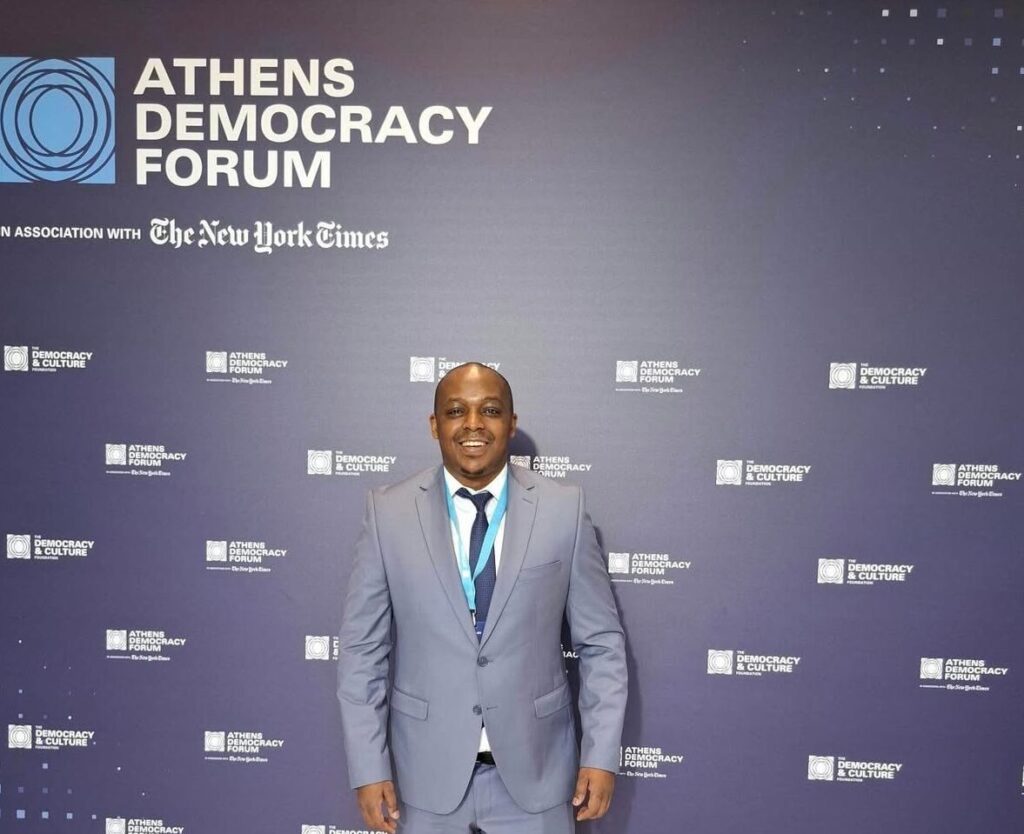
Photo caption
UDA Director of Communication Nathaniel Mong’are during the Athens Democracy Forum at the Academy of Athens, Greece, where he called for reforms to the global financial system.
By Mary Ndanu
Athens, Greece
UDA Director of Communication Nathaniel Mong’are has called for reforms to the global financial system, saying it should be made fairer and more equitable for developing countries.
Speaking at the Academy of Athens on the sidelines of the Athens Democracy Forum, Mong’are said Kenya supports reforms to the global financial architecture to ensure countries in the Global South have access to affordable financing.
He called for the establishment of new financial institutions beyond the World Bank and the International Monetary Fund (IMF), commonly referred to as the Bretton Woods institutions.
Mong’are also noted that the current financial system had disadvantaged developing countries by making it more expensive for them to access credit compared to Western and European economies.
He said countries in the Global South could borrow at costs several times higher than those paid by Western and European economies, limiting their ability to finance development.
Mong’are further noted that the World Bank and IMF were established in 1944, at a time when most African countries, including Kenya, were still under colonial rule and had no role in shaping the institutions.
He said that the institutions were initially established to support the reconstruction of Europe after the Second World War and oversee a fixed exchange-rate system linked to gold.
According to Mong’are, Europe has since been rebuilt, while the link between currencies and gold was abandoned in 1971, meaning the circumstances that informed the creation of the institutions have significantly changed.
He also backed the establishment of the Africa Credit Rating Agency (AfCRA), which the African Union is expected to launch in Mauritius on October 7.
He continued by saying that an African credit rating agency would provide a more accurate assessment of African economies and reduce the continent’s reliance on international rating agencies such as S&P, Moody’s and Fitch.
He argued that the ratings assigned to African countries by the international agencies often contribute to higher borrowing costs, saying an African institution could provide assessments based on the continent’s economic fundamentals.
Mong’are insisted Africa was not seeking special treatment but fair terms in the international financial system.
He called for reforms that would give developing countries a greater voice in global financial institutions and improve their access to affordable financing for development.